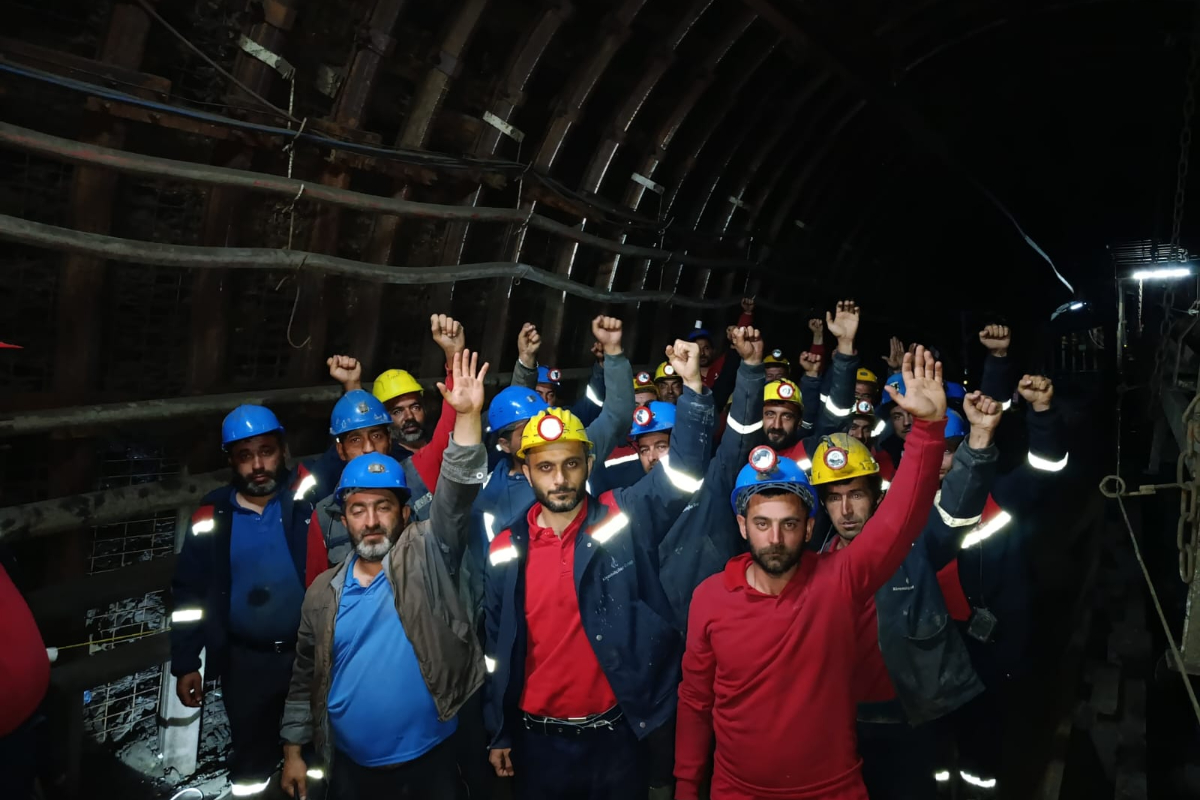
When the workers of Özşen Mining, located in Uzunköprü, Edirne, stopped work on 20 May 2026 under the leadership of the Independent Mine Workers’ Union (Bağımsız Maden-İş), their demands were remarkably simple.
They had worked for months. Hundreds of metres underground, they had carried out one of the hardest and most dangerous jobs in Türkiye. Yet they were not being paid. Some workers had been waiting months for their wages. Overtime pay had reportedly gone unpaid for nearly a year. Retired miners had not received their severance payments and other legal entitlements. As the Eid holiday approached, many mining families were facing severe financial hardship.
Through Bağımsız Maden-İş, the miners repeatedly sought dialogue and called for a negotiated solution. All they wanted was to be paid for the work they had already performed.
They therefore turned first to legal means. Coordinated by Bağımsız Maden-İş, workers exercised their legal right to refrain from work and halted production, calling on the employer to fulfil its obligations.
But the struggle quickly took a different turn.
As workers demanded their wages, at least 21 miners were dismissed. According to Bağımsız Maden-İş, the employer chose to escalate pressure rather than resolve the dispute. The cafeteria used by striking workers was closed. Later, even the prayer room was shut to them. Miners were forced to perform their prayers outside its locked doors.
Throughout the first week, workers maintained their presence at the mine site. They then began marching in order to make their voices heard more widely. They walked to Cumhuriyet Square in Keşan. The banners they carried did not call for privileges or special treatment. Their message was simple:
“We are not asking for charity. We are asking for the fruits of our labour.”
As no solution emerged, the protests expanded.
In the first days of June, workers marched to Tekirdağ, where the company’s owners are based. Their demands remained unchanged: payment for the work they had done and for the rights they had earned over years of labour.
At the same time, the struggle began exposing another reality.
On 4 June, a fire broke out at the mine. Workers and representatives of Bağımsız Maden-İş stated that they had long warned about inadequate maintenance and occupational safety deficiencies. The fire revealed that this struggle was not only about wages; working conditions themselves had become a serious concern.
By the end of the second week, the struggle had grown beyond the story of a few unpaid workers. Miners’ families began joining the protest. Wives, children and retired miners became part of the resistance. Through the solidarity network organised by Bağımsız Maden-İş, the dispute gained visibility across the region.
By the nineteenth day, workers were demanding not only their unpaid wages, but also the reinstatement of dismissed colleagues, payment of compensation owed to retired miners, and the implementation of adequate occupational health and safety measures.
The miners continued searching for ways to make their voices heard.
On the twenty-third day of the struggle, they announced a new action plan. They intended to attend the reopening ceremony of the Selimiye Mosque, where President Recep Tayyip Erdoğan would be present, then make their voices heard at a CHP rally, and, if no solution was reached, march to Ankara as a last resort.
On 12 June, they attempted to reach the event attended by Erdoğan.
They were stopped by the police.
Miners and their families, seeking only to make their voices heard by the country’s highest political authority, were met with police intervention. Workers were detained. Yet they refused to back down.
The third week of the struggle was coming to an end.
For twenty-four days they had waited outside the mine, marched, held press conferences and sought negotiations. Nothing had changed.
So on 13 June they made a new decision.
The miners went underground.
They launched one of the underground resistance actions that hold a special place in the history of workers’ struggles in Türkiye. They barricaded themselves inside the mine and began a hunger strike.
One miner explained the decision in words that captured the mood of the struggle:
“For 24 days we tried every possible way to make our voices heard above ground. Now we are underground. Either we will die, or we will win our rights.”
Then communication with the miners underground was cut off.
According to Bağımsız Maden-İş, the employer disabled the control centre through which regular contact had been maintained with the workers underground. This created serious concerns for their safety and wellbeing.
At the same time, journalists covering the resistance also became targets.
Journalist Umut Taştan, who descended into the mine to help bring the miners’ voices to the public, became the subject of a legal investigation. Criticism grew that not only workers’ rights, but also the public’s right to information, was being placed under pressure.
On the twenty-sixth day of the struggle, events took an even more dangerous turn.
The wives and family members of the miners gathered in front of the administrative building to learn about the condition of those underground.
According to Bağımsız Maden-İş, shots were then fired from the administrative building toward workers, family members and union representatives. Three shots were fired from two separate firearms.
By sheer luck, no one was injured.
But the incident changed the course of the struggle.
In response, miners and their families occupied the mine.
What had begun twenty-six days earlier as a demand for unpaid wages had become something much larger. Faced with dismissals, intimidation, police intervention, underground resistance, the severing of communications and ultimately gunfire, the workers’ struggle had become a fight for dignity, security and basic human rights.
To understand this story, one final thing must be remembered.
Mining is among the hardest and most dangerous jobs in the world. In Türkiye, when devastating earthquakes strike, when mining disasters occur, when lives are trapped beneath the rubble, it is often miners who are among the first to enter. These are people who work underground every day with their lives in their hands. They are people who repeatedly risk their own lives to save others.
That is why the struggle of the Özşen miners matters.
Because the people demanding payment for work already performed today are the very same people who, yesterday, descended underground without hesitation to save the lives of others.
Today, the workers of Özşen are fighting not only for their wages, but for the value of their labour, their dignity at work and their right to live as human beings. In that sense, they are fighting not only for themselves, but for all of us.
The Workers’ Demands
- Full payment of all outstanding wages;
- Payment of overtime wages that have reportedly gone unpaid for nearly a year;
- Payment of severance compensation and all other legal entitlements owed to retired miners;
- Reinstatement of workers dismissed for demanding their rights;
- An end to pressure, threats and retaliation against workers;
- Full implementation of occupational health and safety measures;
- Respect for freedom of association and workers’ right to collective representation.