June 2026
More than a labour dispute, the struggle of Doruk Mining workers has become a test of whether commitments made under direct government supervision can be enforced in Türkiye.
Workers employed by Doruk Madencilik, a subsidiary operating within SSS Yıldızlar Holding, have resumed their mobilization in Ankara after a high-profile agreement brokered by senior government officials failed to deliver the promised resolution. The dispute concerns unpaid wages, unpaid compensation, unpaid social security contributions, and other employment-related receivables accumulated over several months.
The case has attracted nationwide attention because of an extraordinary fact: the commitments in question were not merely made by company representatives. They were negotiated in the presence of senior officials from three ministries and were publicly presented as a resolved dispute.
Today, workers argue that the company has failed to fulfill key commitments while the institutions that acted as guarantors have not effectively enforced the agreement.
Months Without Pay
The dispute emerged after workers reported being left without wages for periods ranging from three to seven months. For many mining families, this meant surviving without regular income while continuing to face mounting debts, rent obligations, utility bills, and basic household expenses.
Mining remains one of Türkiye’s most dangerous sectors. Workers employed in hazardous underground and surface operations continued to perform their duties while substantial portions of their legally earned wages remained unpaid.
According to the Independent Mine Workers’ Union (Bağımsız Maden İşçileri Sendikası), the dispute eventually expanded beyond unpaid wages to include:
- Outstanding severance and notice compensation;
- Unpaid leave-related entitlements;
- Missing social security contributions;
- Collective bargaining agreement wage differentials;
- Other finalized worker receivables.
For many workers, these claims represent not future demands but money that has already been legally earned and, in some cases, legally finalized.
A March to Ankara
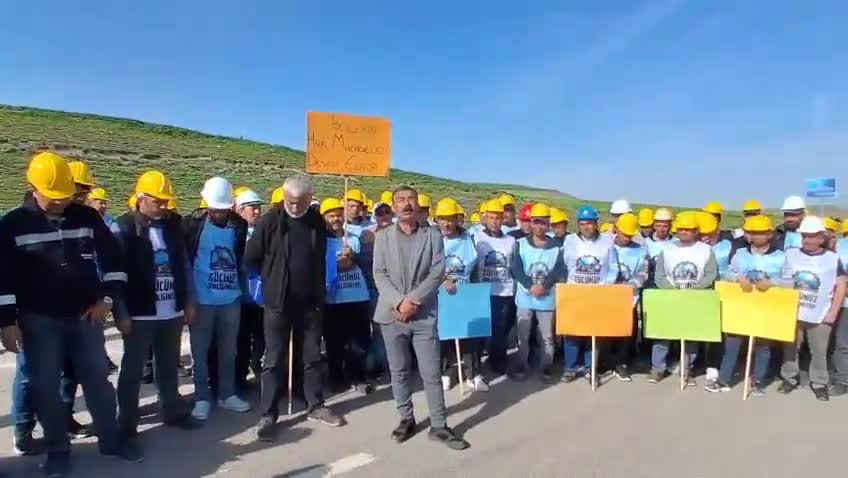
On 12 April 2026, Doruk Mining workers launched a march toward Ankara.
The action quickly became one of the most visible labour mobilizations in Türkiye this year. Workers walked hundreds of kilometres, established protest camps, and eventually began a hunger strike in front of the Ministry of Energy and Natural Resources.
Police interventions and detentions followed. Images of miners, many still wearing work clothes and helmets, confronting security forces in the capital generated widespread public sympathy.
The struggle drew support from trade unions, labour organizations, academics, journalists, opposition politicians, and ordinary citizens. Public pressure steadily increased on both the company and government institutions.
Government Intervention and a Public Commitment
On 28 April, after days of protest and hunger strike, a high-level meeting was convened.
Participants reportedly included:
- The Minister of Interior and his Deputy;
- The Deputy Minister of Energy and Natural Resources;
- The Deputy Minister of Labour and Social Security;
- Senior ministry bureaucrats;
- The Director General of Security;
- The Chief of Ankara Police;
- Executives of SSS Yıldızlar Holding;
- Representatives of the Independent Mine Workers’ Union and the workers themselves.
At the conclusion of the meeting, workers were informed that their demands had been accepted and that all outstanding receivables would be paid by 15 May 2026.
The miners suspended their protest based on these assurances.
The significance of this agreement cannot be overstated. This was not a private understanding reached behind closed doors. It was presented as a solution achieved through direct state mediation and supervision.
Promises Broken
Some payments were subsequently made.
Workers received several months of overdue wages and collective bargaining agreement wage differentials. However, substantial compensation claims and other receivables remained unpaid.
According to the union, the company repeatedly postponed payments, requested additional time, and continuously announced new deadlines that were subsequently missed.
The union reports maintaining regular communication with senior company management throughout this period. Despite repeated assurances that payments would be completed, the commitments were not fulfilled.
Even after additional meetings at company headquarters, workers were informed that promised payment schedules would once again be postponed.
By late May, the agreement had effectively collapsed.
Questions for the Guarantor Ministries
The dispute has now evolved into a broader question concerning accountability and state responsibility.
Workers argue that three ministries directly participated in brokering the settlement and publicly assumed a guarantor role.
The union states that it repeatedly informed the relevant ministries that the company was failing to meet its obligations. Nevertheless, no effective enforcement mechanism appears to have been activated.
As a result, workers now find themselves asking a fundamental question:
What is the value of a government-brokered settlement if workers cannot rely on its implementation?
This question extends beyond the Doruk Mining case and touches on the credibility of state-mediated labour dispute resolution mechanisms in Türkiye.
Allegations of Support for a Yellow Union
One of the most controversial developments concerns allegations that the company transferred approximately 10 million Turkish Lira to a pro-employer union while workers’ finalized receivables remained unpaid.
The Independent Mine Workers’ Union describes this payment as a reward for a yellow union that allegedly helped maintain employer control over workers and weaken independent worker representation.
If confirmed, such allegations would raise serious concerns regarding freedom of association and the integrity of collective labour relations.
Workers argue that there can be no legitimate justification for transferring millions of lira to a compliant union structure while delaying payments already legally owed to workers.
Return to Resistance
On 23 May, the Independent Mine Workers’ Union announced that it no longer accepted either company promises or governmental guarantees as sufficient.
The union declared that protests would resume and continue until:
- All outstanding compensation claims are paid;
- All unpaid leave-related wages are settled;
- Associated social security contributions are deposited;
- All remaining worker receivables are paid in full.
Beginning on 1 June, Doruk Mining workers and their families once again mobilized in Ankara.
The areas surrounding both the company headquarters and the institutions that acted as guarantors have been declared sites of resistance.
Why This Case Matters Internationally
The Doruk Mining dispute is no longer solely about unpaid wages.
It has become a significant test case concerning:
- Enforcement of workers’ economic rights;
- Access to effective remedy;
- Accountability of corporate actors;
- Credibility of government-brokered labour agreements;
- Freedom of association and independent trade unionism;
- Protection of workers in a high-risk extractive industry.
The dispute also raises broader concerns regarding whether workers can realistically depend on state institutions to guarantee agreements reached after large-scale public mobilizations.
For international labour organizations, global union federations, human rights groups, and labour journalists, the case deserves close attention not only because of the unpaid claims involved but because it highlights a deeper issue: the gap between commitments publicly made to workers and the mechanisms available to enforce them.
As of June 2026, Doruk Mining workers remain in struggle. Their message is simple: promises have been made, agreements have been signed, and workers have waited. What remains unresolved is whether those commitments will finally be honored.