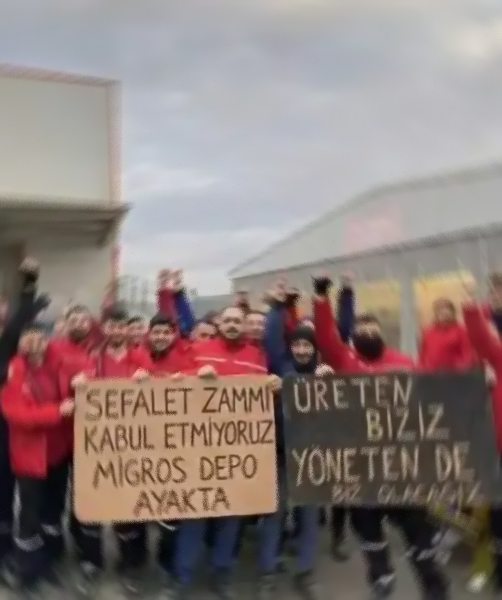
Dear Migros Türkiye and EBRD Executives, it’s us again.
During the Migros warehouse workers’ resistance in 2022, we addressed an open letter to you and, in the context of the European Bank for Reconstruction and Development’s (EBRD) EUR 60 million gender-equality-linked facility allocated to Migros at the time, we questioned whether this financing complied with the criteria the Bank applies when extending such funding—and through what relationships and assurances it was being channelled. The Migros that the EBRD praised so lavishly was, through this facility, supposed to deliver gender-balanced employment across its workforce, improve the energy efficiency of its store network, and demonstrate measurable progress on sustainability. As we all know, capitalist corporations can make grand promises on paper under headings such as gender equality or the green transition; yet when it comes to implementation, they often demand public resources to finance that “transition.” Such facilities also function as a shop window—an instrument for reputational enhancement. At the time, we asked the EBRD a simple but critical question: were Migros warehouses included within the scope of these sustainability and equality-linked funds? Because the picture the EBRD painted of Migros did not match what was happening in reality. The accounts given by warehouse workers pointed to a radically different reality: the risk of pallet trucks (transpallets) toppling heavy loads onto workers; overtime extending up to 13 hours per day; monthly overtime reaching 100–120 hours yet being underpaid; inadequate ventilation and climate control; mobbing; ill-treatment; and allegations of gender-based discrimination. It was also reported publicly that, during the same period, warehouse workers attempted to organise under a union of their own choosing but that this process was obstructed; that workers were pressured toward employer-aligned unions; and that, during protests, they were removed from workplaces through the use of law enforcement. We also asked how a gender-equality-labelled facility could be reconciled with allegations of invasive searches of women workers, harassment, and threats. The reason for reiterating this today is straightforward: workers themselves state that, over nearly four years, there has been no meaningful improvement in their working conditions. The EUR 60 million was disbursed; yet for workers, the reality did not change. Some may say: “An international bank can lend to whomever it wants—why should you care?” But this is not an ordinary private bank. The EBRD is a multilateral development finance institution operating with public funds, with more than 70 countries among its shareholders, as well as the European Union and the European Investment Bank, represented by finance ministers. In other words, this financing is provided through public resources at a global scale—put simply, our money. What is even more striking is that a few years after the gender-equality facility, the EBRD opened a new credit package for Migros of approximately EUR 94 million under a green transition and investment programme. We could, at this point, discuss at length how a bank established—at least purportedly—to promote the free market circulates “freely” through certain networks and repeatedly returns to Migros with fresh financing. But let us keep to the matter at hand. To quote verbatim: “Through the Project, the Borrower will finance (i) investments for new store openings and refurbishment of existing stores across the country and (ii) renewable energy investments, under its capital expenditure programme in Turkey (the Project).” Let us summarise: with this loan, Migros will open new stores or refurbish existing ones. So what—will it cause less environmental harm from now on? And crucially: Migros’s promise not to harm the environment will be financed with public resources. Let us be clear: we are financing the store openings and refurbishments of a major corporation so that it may “do less harm.” So what does this have to do with the warehouse workers’ resistance at Migros? While financing such a project, the EBRD claims it supports companies that meet the performance requirements set out under its Environmental and Social Policy. In effect, it says: “We are spending your money—but look carefully at whom we are spending it on.” The rules the recipient company must meet are captured in Performance Requirement 2 (PR2). Now, let us look at the portrait drawn in the EBRD’s project summary with respect to these requirements: “The Company’s employees are unionised and covered by a collective bargaining agreement. In addition to its Human Resources Policy compliant with Performance Requirement 2 (PR2), it also has Human Rights and Equal Opportunities policies. The Company has prepared a comprehensive plan to remove barriers to women’s labour force participation and has adopted a proactive approach to implementing policies to prevent Gender-Based Violence and Harassment. Employee representatives sit on the Occupational Health and Safety (OHS) committee, and risks are identified in a digital Health and Safety Management System.” Did you notice a small problem? This portrait is fundamentally at odds with the reality described by workers who have been resisting for days in Migros warehouses. So we ask the EBRD: let us assume you “did not know” when you extended the 2022 gender-equality financing. Yet even then, the warehouse workers’ actions and the working conditions in Migros warehouses inevitably entered the public domain. Did you truly see no need to investigate these actions and the allegations raised by the workers and by the union they chose? Did it not occur to you to take preventive measures, to anticipate risks in line with the due diligence obligations promoted by one of your most important shareholders—the European Union? In short: were the allegations of rights violations concerning warehouse workers that entered the public domain in 2022 examined by the EBRD under PR2? If they were, what were the findings? If they were not, how does the EBRD verify PR2 compliance? The EBRD states in its project documents that it monitors the social performance of its clients. If you would clarify whether these monitoring processes rely solely on company reports and corporate representations, or whether workers’ testimonies and independent field data are integrated into such processes, the public would be grateful. It is precisely because you did not carry out such scrutiny that we are now compelled to critically examine—here, publicly—the claims contained in the project summary documents of a Migros to which you have again extended EUR 94 million: claims that its employees are unionised; that they are covered by a collective agreement; that the company has human rights and equal opportunities policies; and that it uses digital systems in occupational health and safety—indeed, the claim that it meets PR2 criteria. PR2 does not merely require companies to adopt policies on paper. It requires that freedom of association be effectively protected; that meaningful collective bargaining processes be carried out; and that workers be able to claim their rights without fear of retaliation. Warehouse workers’ demands—union representation, wage increases, secure employment and the curtailment of subcontracting—directly concern the practical application of these standards. First, we must address Migros’s claim that it is a unionised workplace. It is known that, in Migros stores, Tezkoop-İş holds collective bargaining authority. Yet for a long time, warehouses were kept outside this union’s sectoral scope. The reason was your decision—motivated by profit maximisation—to outsource warehouse operations on the claim that they were not part of the core business. And the outsourced entities were not sought far afield: the former and “trusted” branch heads of the union that has served you as the “appropriate” union for years became the owners of these subcontracting companies. However, the moment workers in your warehouses began organising under DGD-SEN to defend their rights, you reversed course and asserted that warehouse work is part of Migros’s core business—then changed the sector classification again to make your “appropriate” union appropriate once more. Moreover, while the union arrangement in stores remained intact, leading workers in warehouses who organised under DGD-SEN and raised demands were dismissed. There is no way to call this freedom of association. If anything, it is “freedom of association in Migros’s union.” Therefore, freedom of association is the most critical dimension of the Migros case. International standards require that workers be represented through the union of their own choosing and that employers do not interfere in this process. The tensions in warehouse workers’ organising processes raise serious questions about the inclusiveness and legitimacy of collective bargaining processes. Wages sit at the heart of this discussion. PR2 does not consider mere compliance with the legal minimum wage sufficient; it envisages wages that are consistent with sectoral norms and adequate in the context of living costs—i.e., a level compatible with decent work. In high-inflation conditions, warehouse workers’ statements that they have suffered real income erosion show that social sustainability criteria must be assessed not only theoretically, but through material living conditions. Warehouse operations constitute an extremely arduous and dangerous line of work. Workers are not compensated in a manner commensurate with the nature of the work; they are effectively confined to the minimum wage. This forces workers in a hazardous workplace to work excessive overtime simply to survive. This pressure of excessive work, combined with occupational health and safety deficiencies, makes workplace accidents inevitable. Furthermore, because workers are subject to income tax, their take-home pay toward the end of the year falls below even the statutory minimum wage. This is precisely why workers demand a 50% wage increase and that the tax burden be borne by the employer. This situation is plainly far outside the decent wage and working conditions envisaged by PR2. The pace of work and workload are also issues that must be assessed under PR2. Given the structural risks inherent in logistics and warehouse operations, performance pressure and high-volume dispatch tempo create significant occupational health and safety risk areas. PR2 requires not merely the existence of OHS procedures on paper, but the establishment of systems that ensure workers are, in practice, able to work in safe conditions. All of this exposes a core problem faced by international financial institutions in their sustainability assessments: the gap between corporate reports and policy documents on the one hand, and workers’ lived experiences on the other. The Migros case shows that social sustainability cannot be evaluated solely through ESG reports and certification processes; workers’ experiences must be placed at the centre of such assessments. In conclusion, the Migros–EBRD relationship constitutes a significant example that calls into question the limits of sustainable finance policies. But the discussion cannot be confined to this alone. If we are speaking of a bank in which the European Investment Bank, the European Union itself, and 27 European countries are shareholders, then this is too important to be left here. This bank—where countries such as Germany and France, which have incorporated HREDD obligations into their domestic legal systems, hold substantial influence—must apply PR2 provisions fully and without exception. For the EU and its Member States, which apply HREDD obligations to multinational brands and to companies established in Europe above certain employment thresholds, to remain indifferent to these criteria within a financial institution of which they are part would constitute a further public disgrace. We reiterate that we will not hesitate to bring, in the European public sphere, the fact that financing institutions are also part of supply-chain responsibility—and that we will use every complaints mechanism available to us, including IPAM. But before that, and finally, we consider it our duty to convey once more the workers’ demands to those at the very top. Since our other demands have been met, we have one demand: All 303 workers who were dismissed for asserting their most basic rights—except those who do not seek reinstatement and wish to end the process by receiving their legal entitlements—must be reinstated with their full rights. Until this demand is met, we will continue to seek our rights on every platform made available to us by local and international laws and rules, beginning with our right not to consume.